Age Verification Software to
Keep Minors Out
Keep Minors Out
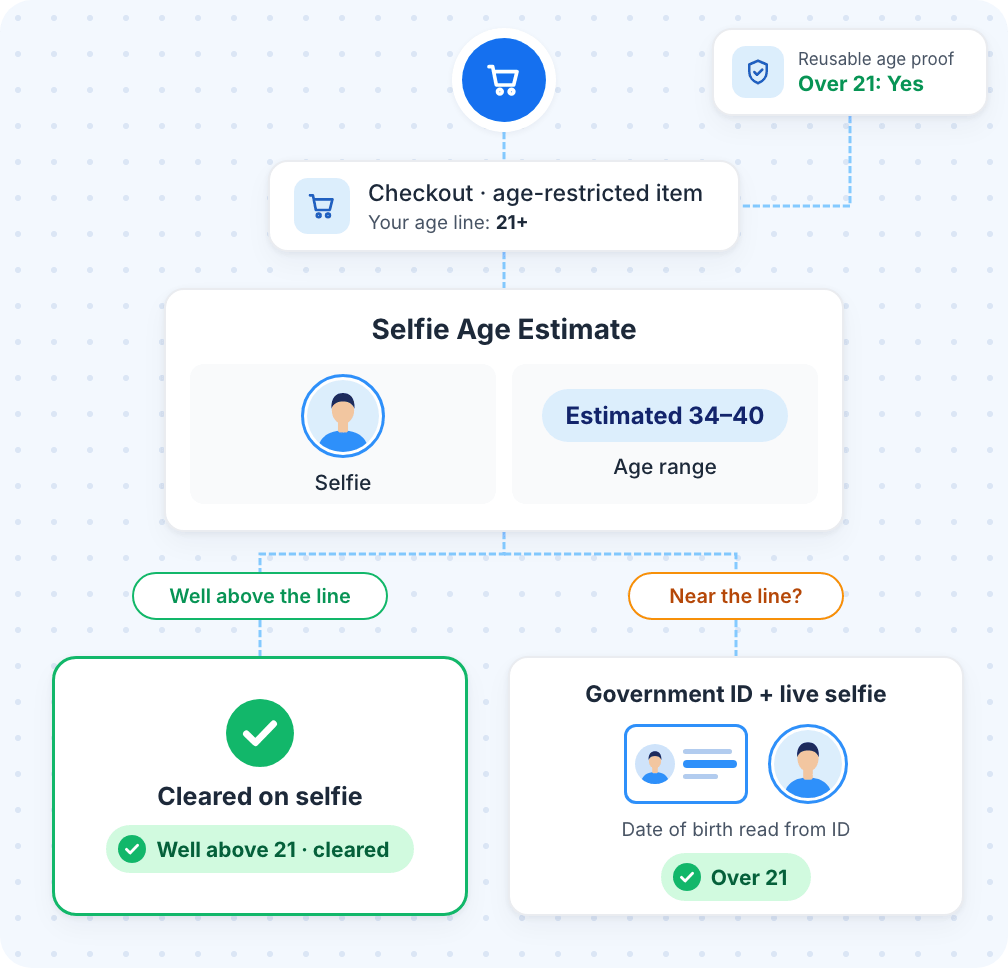
An age checkbox takes the user's word for it. Authenticate's age verification software starts with a selfie estimate, moves anyone near your limit to a government ID and live selfie, and accepts reusable age proofs.
Authenticate is trusted by


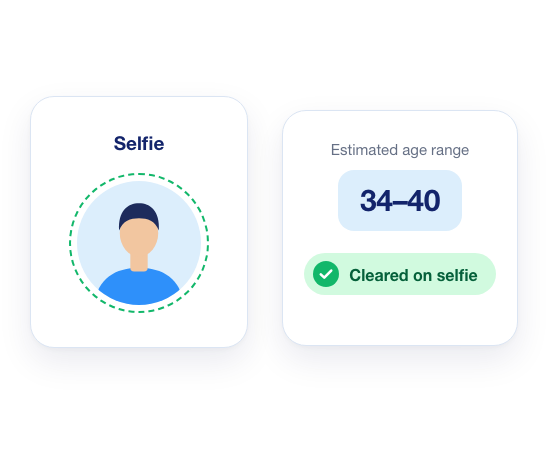
Clear Adults With a Selfie
Facial age estimation runs before any ID step
- Returns an estimated age range
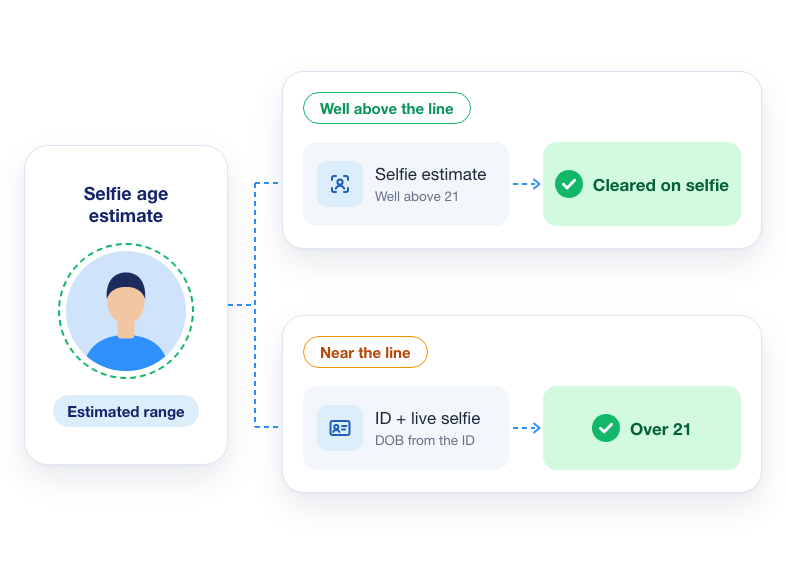
- Adults well past your minimum skip the ID step
- Anyone it can't clear takes the ID check instead
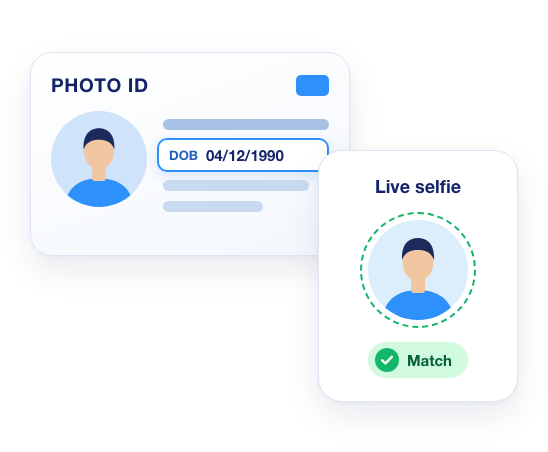
Verify Age From a Government ID
The date of birth comes from the ID itself
- 16,000+ IDs from 254 countries and territories
- Selfie matched to the ID photo, with liveness
- US ID barcode checked against the printed front
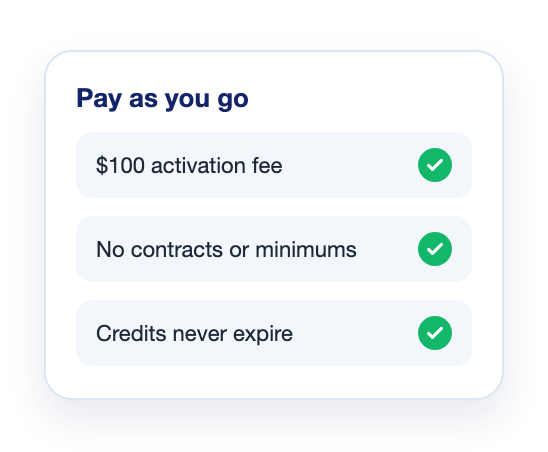
Pay Only for the Checks You Run
No contracts, and no minimums after activation
- $2 per ID check, Liveness & Face Match included
- $100 activation fee credited toward checks
- US database check included once the ID is verified
Age Verification Software With Three Methods in One Flow
Estimate Age First, Then Check an ID When It's Close
Authenticate estimates the user's age from a selfie and returns an age range. Where your rules accept an estimate and the whole range sits well past your minimum age, the user carries on without photographing a document. That's one less step at the point where extra steps cost you signups and sales. Estimates are least certain near the legal age, so a range that comes close goes to the ID check. There, your rule checks the ID's date of birth.

Facial Age Estimation

Government ID Verification

Liveness & Face Match

Medallion™ No-Code Flow
Accept Reusable Age Proofs That Share Only the Answer
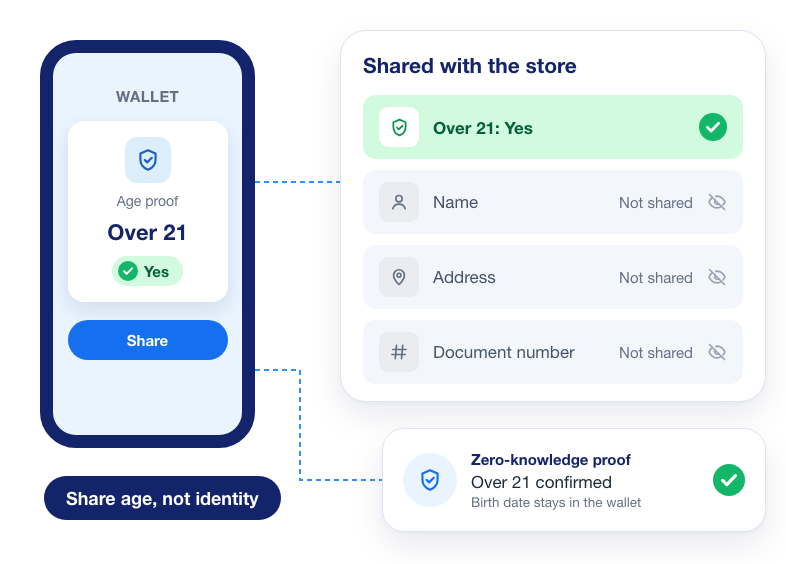
A user holding a reusable digital ID or mobile driver's license can share an over-18 or over-21 answer from it instead of a selfie or document. If their wallet supports zero-knowledge proofs, it proves they're old enough without revealing the birth date behind the answer. You receive the answer with no name, address, or document number attached, so there's less personal data for you to store and protect. Anyone without a compatible credential takes the selfie or ID route.

Reusable Digital ID
Mobile Driver's License
Zero-Knowledge Age Proof

Selfie or ID Fallback
Age Verification API for Signup and Checkout
Put the check at signup, before a restricted page, or at checkout when the cart holds an age-restricted item, so other shoppers never see it. Connect by API, Web SDK, a WebView for the ID check in native apps, or a no-code Medallion link.

Online Age Verification in Three Steps
The first two steps happen on the user's phone: a selfie estimate and an ID check for anyone it can't clear. The third, your age rule, runs once the result reaches your system by API or webhook.

Estimate Age From a Selfie
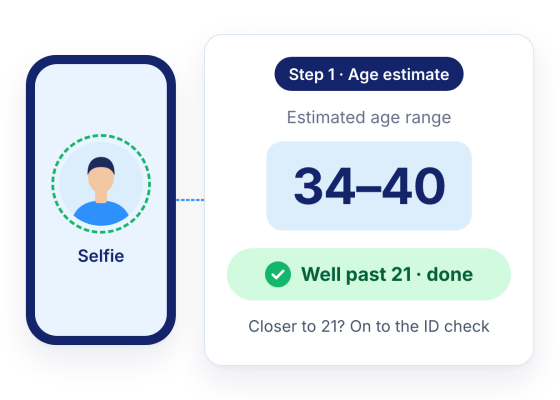
The user takes a selfie, and Authenticate returns an estimated age range. Where your rules allow it, a range well past your minimum ends the check there, so an adult at checkout is through in one photo, with no document. Anything closer goes on to step 2. A user with a reusable digital ID can share an age proof instead of the selfie.

Check a Government ID for Everyone Else
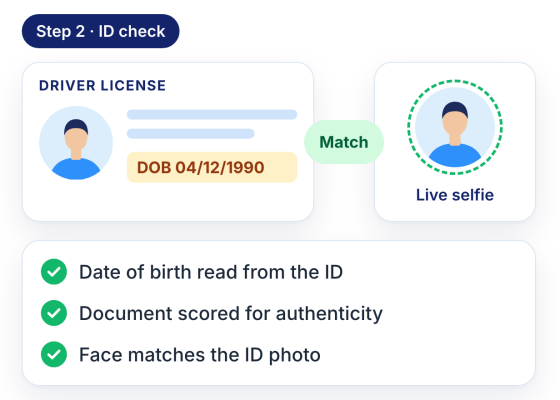
The user photographs a government ID and takes a live selfie on the same phone. Once both images are in, Authenticate reads the date of birth, scores the document's authenticity, and matches the face in the selfie to the ID photo in 30 seconds. The face match is your defense against a borrowed ID, because whoever takes the selfie has to match the ID photo.

Guided flow in 38 languages
Liveness tested to iBeta Level 2
Date of birth returned with the result

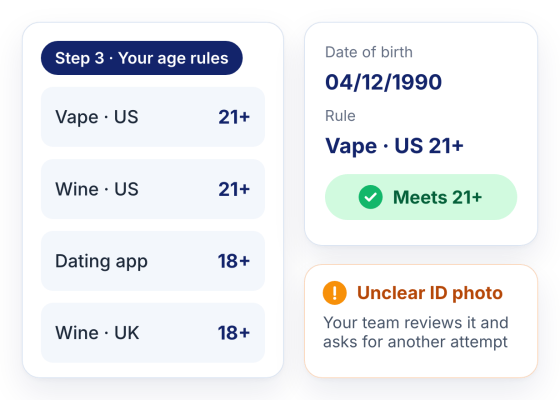
Apply Your Age Rule to the Result
Your system checks each result against the age for the product and the user's location, so one flow can hold one product to 18 and another to 21. If an ID check fails or is unclear, someone on your team can review it and ask for another attempt or a different ID, giving a real adult with a blurred first photo a second chance.
Resources
How to Spot a Fake ID: Face Comes First
Why the face comes before the birth date, what a scanner can prove, and how to check an ID sent to you as a photo.

Document Verification
See how Authenticate reads a government ID and scores its authenticity.
Looking for answers? Ask us anything.
This is your one stop shop to learn all about Authenticate, our features, pricing, & more.
Frequently Asked Questions
Questions from online sellers and app makers about estimates, timing, fake IDs, the law, privacy, and cost.
How does online age verification work?

Online age verification works by checking evidence of a user's age, such as a government ID with a matching selfie or a reusable age proof, before they reach a restricted product, page, or signup. A birth-date field or over-18 checkbox is an age gate, which only records what the user claims. Authenticate puts a selfie age estimate in front of the ID check, so an adult it clears can skip the ID step where the rules allow it.
What is the difference between age verification and age estimation?
Age verification reads a user's age from evidence, such as a government ID, while age estimation predicts an age range from a selfie. You'll also see age assurance, the umbrella term for both, in laws and guidance. Because an estimate is least reliable close to the legal age, Authenticate pairs the two. A user the estimate doesn't clear can take the ID check, where your age rule applies to the date of birth on their ID.
How accurate is facial age estimation?
Facial age estimation's accuracy varies with the algorithm, image quality, and the person's age, according to NIST's 2024 evaluation. That's why an estimate should only clear users who sit well past your minimum, leaving a margin for error. Ofcom's April 2025 guidance builds that margin into a challenge age, and in its worked example, where the minimum age is 18, anyone estimated under 25 goes to a second check. Authenticate's ID step is that second check.
How long does age verification take?
Timing on Authenticate depends on the route, and an adult the estimate clears is done after one selfie. A user who goes on to the guided ID flow takes a minute or two on average to finish it. Authenticate's part, verifying the ID and selfie once both photos are in, takes 30 seconds. The result reaches your system by API or webhook, so your age rule can act on it straight away.
Can a fake or borrowed ID get past age verification?
Fake and borrowed IDs call for different checks, so Authenticate's age verification runs both. A forged or altered ID has to pass a document authenticity score and, on a US ID, a match between the barcode on the back and the printed front. A borrowed ID has to get past the face match, which compares the live selfie with the ID photo. Liveness detection checks that the selfie isn't a printed photo, a screen, or a mask.
How does age verification work for online vape and alcohol sales?
Online vape and alcohol sellers usually check age at checkout and delivery. For vapes, the federal PACT Act requires checking the buyer's name, birth date, and address against a commercially available database, mostly of government data, when the order is placed, then a government photo ID at the door. Authenticate covers checkout with its government ID check and can add a US database check of those details. Ask your counsel whether that meets the PACT Act and your alcohol rules.
How does age verification work for dating apps?
On a dating app, check age at signup, before anyone sees a profile, against the 18 minimum. A selfie age estimate keeps that signup short for adults well past 18. Everyone else takes the ID check, where a minor with an older sibling's license has to get past the face match. The result confirms age, which is a separate question from whether someone is safe to meet.
Which businesses need age verification?
If you sell anything age-restricted online, you need an age check, and the minimum depends on the product and where you sell it. In the US, the common minimums are 21 for vape, tobacco, alcohol, and cannabis, as well as for online casino gaming in New Jersey, and 18 for adult content and dating. Selling into several states or countries means reading each one's rule, because the accepted method can change along with the age.
Can someone verify their age without an ID?
An adult can pass an age check without an ID by clearing a selfie estimate or sharing a reusable age proof from a digital ID or mobile driver's license. Australia's minimum-age rules require social media platforms to offer other methods of age assurance. In New York, the SAFE for Kids Act rules, effective January 25, 2027, require social media companies to offer at least one alternative to a government ID. Each rule sets its own terms, so check them first.
Which laws accept a government ID check for age?
Texas and Louisiana's adult-content laws name government-issued identification as one accepted method. The Free Speech Coalition counted 27 states with age-verification laws for adult websites as of July 2026, each with its own accepted methods. In the UK, Ofcom lists photo-ID matching among methods capable of highly effective age assurance. Photo-ID matching compares the ID photo with an image of the user taken at the point of ID upload. Your counsel can confirm which method and retention terms you need.
Is age verification software safe for privacy?
Whether age verification software is safe for privacy depends on what it collects and how long it keeps it. Authenticate gets every user's consent before any check runs, collects no document from an adult the estimate clears, and shares only the age answer from a reusable proof. Under Authenticate's biometric policy, facial geometry from a one-time ID verification is destroyed within 24 hours, and source photographs within 30 days. Whatever reaches your system follows your own retention policy.
What is the difference between an age verification API and an app store age signal?
An age verification API checks the user directly, while an app store age signal passes along the age tied to their store account. Apple's Declared Age Range and Google's Play Age Signals API (beta) work only in apps, and Google began returning signals for eligible Texas accounts created after May 28, 2026, under Texas SB 2420. Websites need a direct check, which Authenticate's ID check provides through the Web SDK or a verification link, with a WebView for native apps.
How much does age verification cost with Authenticate?
An age check with a government ID costs $2 on Authenticate, Liveness & Face Match included, and you pay for every attempt, pass or fail. A US database check of name, address, and date of birth is included once the same person has been verified by a paid government ID check. The $100 activation fee is credited toward checks, with no contracts and no minimums after activation. Ask us for pricing on selfie age estimation and reusable age proofs.
Age Verification Software Set to Your Age Rules
Authenticate has processed more than 2 million users, and its compliance frameworks include SOC 2 Type II. Use the selfie estimate where the rules allow it and a government ID check where they don't, in one flow you set for each product and market.
Get Started

